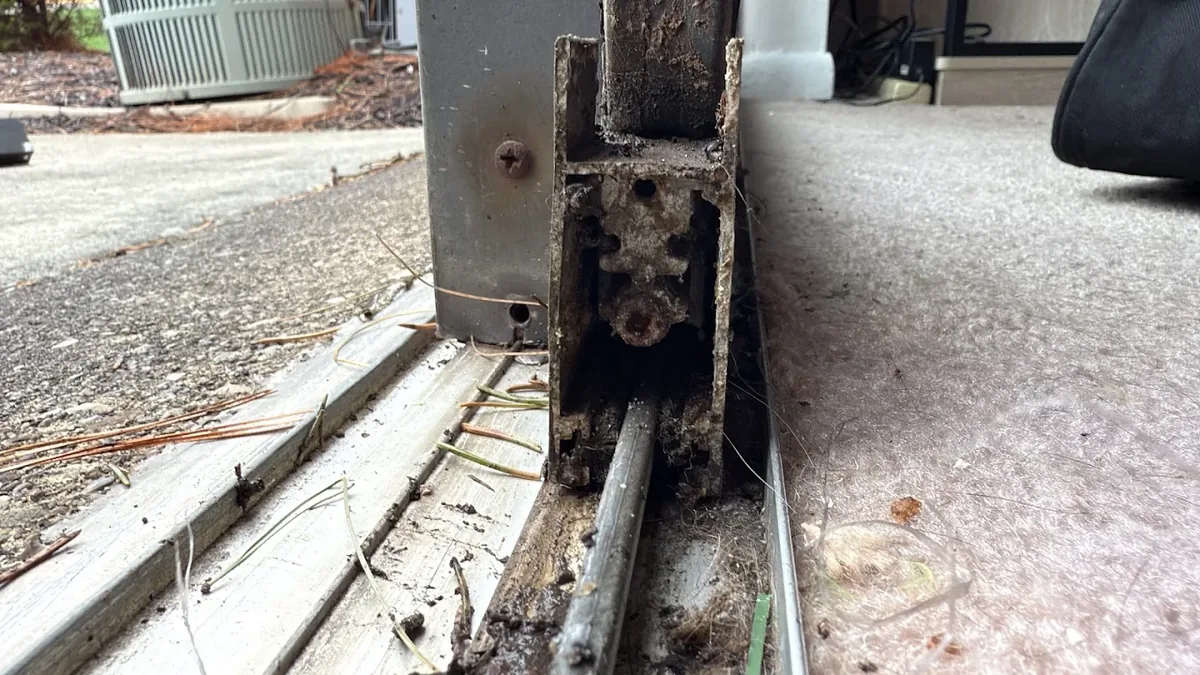
It usually happens in February. The patio door that glided fine in September now takes two hands, a braced foot, and a noise somewhere between a grind and a groan. The good news: you almost certainly do not need a new door. The culprit is one of two inexpensive parts — the rollers underneath the panel, or the track they ride on — and both are routine sliding door repair work.
The Two-Minute Diagnosis: Roller or Track?
Before you call anyone, you can narrow it down yourself. The test exploits one simple fact: a patio door roller only carries load while the panel's weight is sitting on it. Take that weight away and a roller fault disappears, while a track fault does not.
The Lift Test
- Slide the door to the spot where it binds the worst and stop there.
- Slip a flat pry bar or sturdy putty knife under the bottom rail and lift the panel about a quarter inch.
- While holding that lift, push the door sideways.
- If it now glides freely, your rollers are worn or seized.
- If it still catches in the same place, the track is deformed, corroded, or packed with debris.
Symptom 1: A Worn or Seized Patio Door Roller
Nearly every sliding patio door rides on two pairs of small wheels called tandem rollers, mounted in the bottom rail and adjusted by a screw at each end. A builder-grade patio door roller used a nylon wheel on a plain steel axle, typically 1-1/4 inch across. Once those bearings flat-spot, the wheel stops rolling and starts dragging — which is exactly what that grinding noise is.
Signs your rollers are the problem
- The door feels heavy across its entire travel, not just at one spot
- A rhythmic click, squeal, or pop that repeats as the door moves
- The panel sits visibly lower on one side, so the lock hook misses the keeper
- Lifting the panel makes the problem vanish instantly
The fix is a set of heavy-duty tandem patio door roller carriages running stainless ball bearings, which cost very little compared to a door and will outlast the originals several times over. While the panel is out, the roller cavity gets cleaned, the track gets vacuumed of salt and grit, and the height screws get recalibrated so the panel sits square in the opening again. That is the standard visit on Pittsburgh patio doors.
Symptom 2: A Damaged or Corroded Track
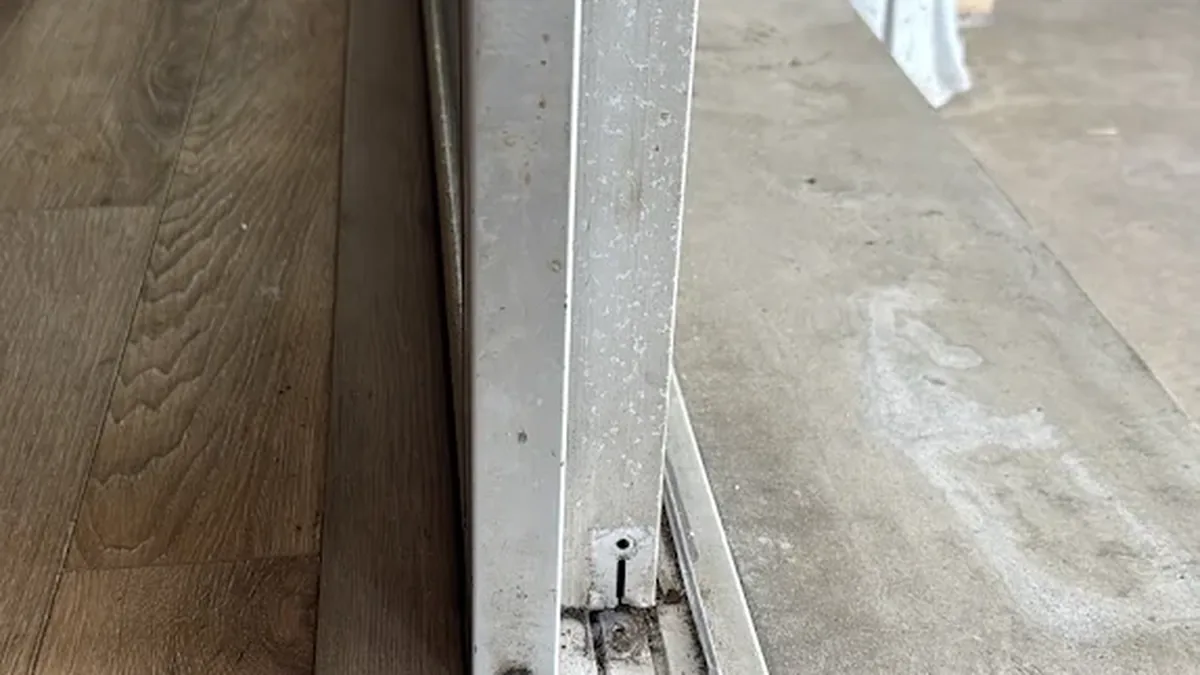
The bottom track is a thin aluminum extrusion. It was never designed to survive what a Pittsburgh winter does to it. Once the raised running lip is crimped, curled, or pitted through, even brand-new rollers will chew themselves up within a season or two.
Signs the track is the problem
- The door catches at the same specific spot every time
- You can see dents, a flattened lip, or a chewed groove in the track
- White chalky residue, pitting, or rust along the sill channel
- The door derails or climbs out of the track entirely
- Someone already replaced the rollers and it still binds
In most cases the frame does not need to come out. A precision-formed 304 stainless track cap bonds directly over the damaged aluminum, giving you a hardened running surface that salt cannot pit. Where the extrusion has corroded through, the sill track section is replaced outright. If the panel glass has also hazed over, that is an independent failure: foggy double-pane windows come from a broken seal, not from the track.
Why This Happens So Often in Western Pennsylvania
Pittsburgh is genuinely harder on sliding doors than most of the country, and it comes down to two overlapping forces.
The local failure drivers
- Freeze-thaw cycling: we cross 32°F in both directions 60 to 70 times a winter. Water wicks into the track, freezes, expands, and slowly deforms the aluminum lip while cracking plastic roller housings.
- Road and sidewalk salt: de-icer tracked in from the deck and driveway dissolves in meltwater and sits in the sill, forming an electrolytic paste that pits aluminum and rusts steel bearings from the inside out.
- Clogged weep holes: when the sill's drainage holes pack with grit, that salty water has nowhere to go and simply sits against the metal until spring.
- Humid summers: Ohio Valley humidity swells wood and clad-wood frames, which is why some doors bind only in July and August.
What About Drafts and Whistling?
If your door is both hard to slide and leaking cold air, those two symptoms share a root cause. Worn rollers let the panel sag out of square, which opens a wedge-shaped gap at the interlock stile and prevents the weatherstripping from compressing. Correcting roller height usually closes the gap; replacing the flattened bulb seals finishes the job. In a long Pittsburgh heating season, that repair tends to pay for itself.
Repair or Replace? An Honest Answer
Replacement sales pitches are common, so here is the straight version. About nine out of ten sliding doors we inspect in the Pittsburgh area are fully restorable with a patio door roller set, a track cap, realignment, and new weatherstripping — for a small fraction of a replacement cost. Replacement genuinely makes sense in only a few situations: the frame itself is rotted or structurally racked, the glass and frame are both failing at once, or you are deliberately upgrading to a different door style.
Repair is the right call when
- The frame is sound and square
- The glass is intact and not fogged
- Only the rollers, track, lock, or seals have worn out
- You want the original door's look and trim preserved
Get a Straight Diagnosis
Run the lift test, then tell us what you saw. We can usually identify the part and quote a flat rate over the phone, and we service Pittsburgh plus every community in the surrounding counties — Allegheny County and nearby parts of Washington, Westmoreland, Butler, and Beaver Counties.
Questions We Get on This Exact Problem
Answered by the technicians who run these calls every week across the Pittsburgh metro.
How do I know if my patio door needs new rollers or a new track?
Lift the panel slightly with a pry bar at the bottom rail. If it suddenly slides easily while lifted, your rollers are worn. If it still catches at the same spot while lifted, the track itself is damaged and needs capping or replacement.
Why do Pittsburgh sliding doors fail so often in winter?
Western Pennsylvania sees 60 to 70 freeze-thaw cycles each year. Meltwater carrying sidewalk salt pools in the bottom track, freezes overnight, expands, and deforms the aluminum lip while corroding the steel roller bearings.
Can I just spray lubricant in the track to fix a heavy sliding door?
Silicone or dry PTFE spray may help briefly, but it cannot restore flat-spotted or seized bearings. Avoid oil-based lubricants entirely — they trap grit and accelerate wear on both the rollers and the track.
Is it cheaper to repair a sliding door or replace it?
Repair, by a wide margin. Roller replacement with track service and realignment typically costs a small fraction of a full patio door replacement, and about nine out of ten doors we see in Pittsburgh are fully repairable.
How long should new sliding door rollers last?
Stainless steel tandem ball-bearing rollers installed on a clean, capped track commonly last 10 to 15 years in our climate. Builder-grade nylon rollers on a corroded track often fail in under five.